
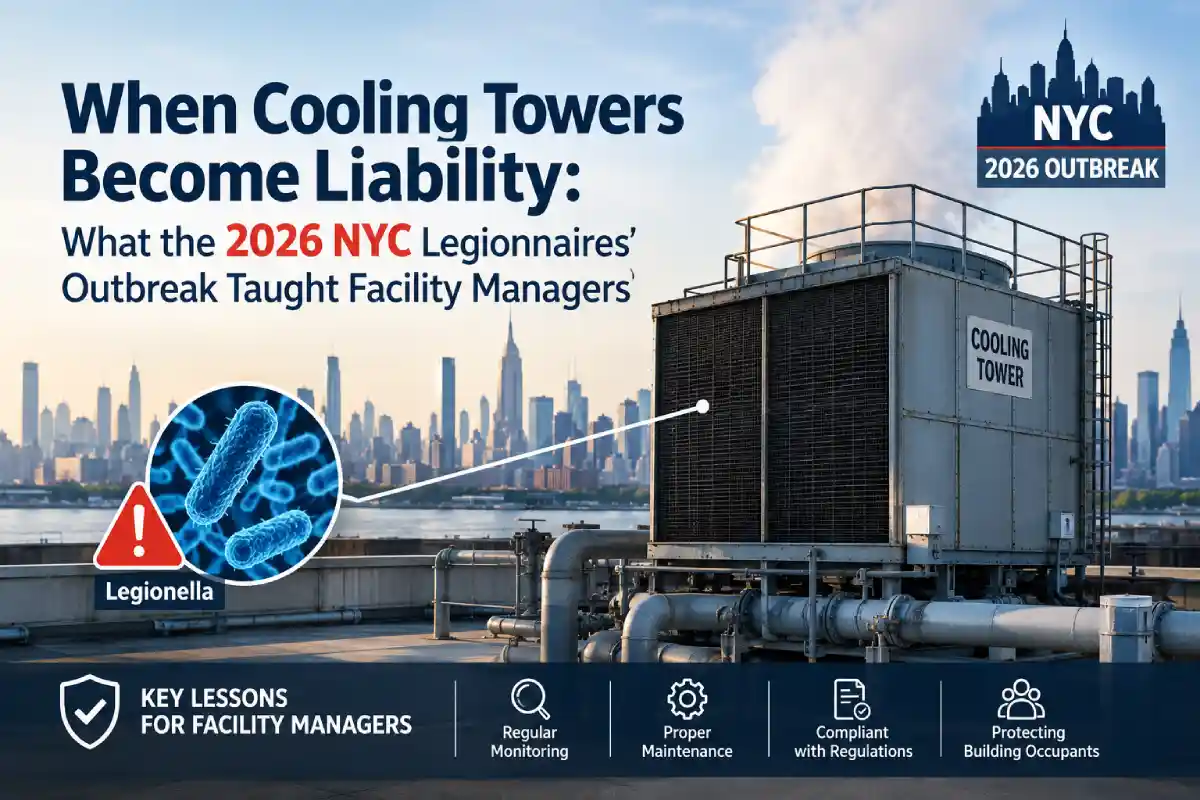
The 2026 Legionella outbreaks in New York City changed how facility managers think about cooling towers. What started as inadequate testing and maintenance led to deaths, regulatory crackdowns and a complete overhaul of requirements. Facility managers who wait for problems to surface accept operational and legal risk that regulators and building owners no longer tolerate.
Table of Contents
Two Outbreaks Traced to the Same Cooling Tower Failures
New York City faced two distinct Legionella clusters in 2026, both traced to contaminated cooling towers that revealed widespread failures in testing frequency, tower registration and contamination monitoring. More than 75 cooling towers tested positive for Legionella bacteria.
The Upper East Side cluster ran from July through August, affecting ZIP codes 10028, 10075 and 10128 with 94 confirmed cases and 11 deaths. Data documents this as the deadliest cluster since a 2015 Bronx event that killed 17 people.
The South Bronx cluster emerged in September, resulting in 23 cases and two deaths across the Melrose and Morrisania neighborhoods, including ZIP codes 10451, 10456, 10455 and 10459. Seven cooling towers were confirmed to have live Legionella contamination. Both outbreaks spread through evaporated airborne water released from contaminated systems, underscoring that cooling towers remain the primary risk for neighborhood-scale outbreaks.
The Compliance Gaps Both Outbreaks Exposed
The Upper East Side investigation revealed gaps in testing adherence and registration oversight, with citywide compliance for cooling tower testing standing at only 80% during the outbreak. One in five registered systems failed to meet requirements. An unregistered cooling tower at 300 E. 83rd St. accumulated 11 violations and $11,000 in fines, demonstrating how enforcement gaps create public health blind spots.
These gaps represent scenarios that specialized water treatment firms like Chardon Labs help facilities avoid through consistent monitoring and documentation. Buildings that maintained rigorous testing protocols avoided being subject to enforcement actions. The difference between a compliant system and liability often comes down to whether facilities treat testing as a recurring discipline or an afterthought.
New York’s Regulatory Overhaul and the National Compliance Shift
City and state authorities responded with sweeping changes that increased the frequency of Legionella testing and substantially raised the maximum fines. New York City implemented more frequent testing requirements effective May 8, 2026, shortening the testing interval from every 90 days to every 31 days while allocating $13 million to enforcement and hiring 23 additional water ecologists.
Governor Hochul signed state legislation strengthening inspections in August 2026, requiring biannual certifications and fines of at least $12,000 for violations resulting in death or serious injury. The penalty structure now treats contaminated cooling towers as public health hazards rather than administrative oversights.
Facility managers outside New York should recognize these changes as part of a nationwide shift in which regulators are raising testing requirements and enforcement standards across the sector.
Cooling Tower Testing Rigor as an Industry Standard
The post-2026 regulatory environment has made adherence to recognized standards nonnegotiable. The American Society of Heating, Refrigerating and Air-Conditioning Engineers (ASHRAE) Standard 188 and Guideline 12 establish the framework for water system risk management that facilities must follow. ASHRAE developed these protocols to demonstrate commitment to Legionella control that regulators now expect.
Chardon Labs offers one example of how a specialized water treatment provider can support cooling tower testing and documentation needs. The company’s ISO 9000 certification supports consistent procedures, while its same-day electronic service reports and archived records help facilities maintain audit readiness.
This documentation approach directly counters the blind spots that plagued the 2026 outbreak investigations. Fixed annual pricing models that align provider incentives with water and energy conservation help facilities avoid the cost unpredictability that comes with reactive contamination responses.
Technical staff at Chardon Labs explain that “Testing reveals the state of process water in your towers. Over time, untreated water becomes biologically contaminated with algae and bacteria, including Legionella. These contaminants may lead to the growth of biofilms, reducing system function, including heat transfer efficiency. When airborne, they may cause health risks to surrounding people.”
Testing involves chemical titrations and color comparator tests performed at critical system points. Chardon Labs’s experts mention chemical analysis includes titrations like calcium hardness, alkalinity and chloride alongside color comparator tests for chlorine, ammonia, molybdate, hydrazine and pH levels. Samples gathered from the basin, drift eliminators and water distribution system provide the technical precision that distinguishes compliant operations from those treating testing as a formality.
Building a Proactive Cooling Tower Water Management Program
Reactive compliance strategies failed during the 2026 outbreaks, demonstrating that facilities need structured programs establishing consistent maintenance activities. An effective water management program addresses documentation, monitoring, maintenance and response protocols.
Site-specific documentation forms the foundation. Facilities should maintain detailed logs of system configurations, water sources and treatment histories that create accountability and traceability. Regular water parameter monitoring tracks temperature, pH, biocide levels and flow rates to detect conditions favoring bacterial growth before they become hazards.
Routine maintenance schedules ensure drift eliminator cleaning, basin inspection and system component evaluation follow documented intervals. Response protocols define clear actions when test results indicate elevated Legionella levels or when inspections reveal biofilm accumulation.
The model that proved effective during outbreak investigations combined remote monitoring with on-site technical support to enable early detection and rapid response. Providers that offer consultation on water and energy efficiency alongside compliance testing help facilities optimize operations beyond minimum regulatory requirements.
Frequently Asked Questions
Facility managers implementing cooling tower water management programs often face questions about regulatory requirements and vendor qualifications.
How often should a cooling tower be tested for Legionella?
New York City now mandates testing every 31 days, a significant increase from the previous 90-day requirement. The CDC recommends that testing frequency should be determined by water management program performance, meaning facilities with strong records may justify less frequent testing, while those with historical issues may need more intensive monitoring.
What triggers a health department order to clean and disinfect a cooling tower?
During the 2026 NYC clusters, towers that returned positive cooling tower test results were ordered to be cleaned and disinfected. The outbreaks showed why facility managers need documented testing, monitoring and response protocols before a positive result becomes an enforcement or public health issue.
Can Legionella be completely removed from a cooling tower system?
Legionella occurs naturally in water systems and cannot be fully eliminated. The goal of any water management program is control through consistent Legionella preventative maintenance. Systems that maintain proper biocide levels, adequate flow rates and regular cleaning schedules keep bacterial populations below thresholds that pose health risks.
What should facility managers look for in a cooling tower testing partner?
Facility managers should look for a partner that supports consistent testing, clear documentation and timely reporting. Same-day electronic service reports, archived records, technical monitoring and water management support can help facilities maintain audit-ready records and respond quickly when testing identifies elevated risk.
Cooling Tower Risk Management Starts Long Before the Next Outbreak
The 2026 Legionella outbreaks proved that reactive compliance strategies leave facilities vulnerable to liability that building owners and insurers will not accept. The regulatory response in New York reflects a national shift toward proactive oversight, in which testing rigor defines industry standards. Facility managers who treat cooling tower water management as a technical discipline position their operations to meet regulatory standards now enforced across jurisdictions.
