

Today business technology is far more than simply IT for communication. In fact, everything from AI to, cloud computing, data analysis, security technology, and automation will affect a business. Without a real business technology strategy and the right solutions that can reduce manual labor while boosting cooperation, protecting crucial information, and ensuring a prompt business response to changing marketplace environments, it can lead to unexpected expenses, security vulnerabilities, and convoluted work-streams.
In our guide we’re going to explore of the most essential business technology solutions that any business can use, including how to build a workable technology plan and key consideration to know before investing in digital technology solutions:
Business technology solutions and strategies are how an organization takes advantage of technology and business-oriented systems/solutions to enhance productivity and efficiency along with improving an organization’s bottom line in the long run.
Table of Contents
What Are Business Technology Solutions & Strategies?

Business technology solutions include the digital tools and systems that help an organisation perform its everyday activities. These can range from simple productivity software to advanced artificial intelligence platforms and enterprise systems.
A technology strategy is the plan that determines which technologies a business needs, why they are needed and how they should be implemented.
For example, a company may use:
- Cloud storage for accessing files securely
- Customer relationship management software for managing customer interactions
- Accounting software for financial operations
- AI tools for analysing information and automating repetitive tasks
- Cybersecurity systems for protecting business data
- Data analytics platforms for understanding performance
- Collaboration tools for remote and hybrid teams
The important point is that technology should support a business objective. Buying software simply because it is popular does not necessarily create value.
Why Business Technology Matters
Technology has become closely connected with everyday business operations. Employees may rely on digital platforms for communication, project management, customer support, accounting, marketing and data analysis.
A well-planned technology environment can provide several benefits.
Improved Productivity
Automation and digital workflows can reduce repetitive administrative tasks. Employees can spend more time on activities that require judgement, creativity and customer interaction.
Better Collaboration
Cloud-based collaboration tools allow employees to access documents, communicate and work on projects from different locations.
Faster Decision-Making
Businesses generate large amounts of information through sales, customer interactions, websites and internal operations. Analytics tools can turn that information into useful insights.
Stronger Security
Cybersecurity should be part of the overall technology strategy rather than something added after a system has been implemented. The National Institute of Standards and Technology’s Cybersecurity Framework 2.0 provides organisations with a flexible approach to managing cybersecurity risk.
Greater Scalability
Cloud services and modern software can make it easier for businesses to increase their technology capacity as their operations grow.
Key Business Technology Solutions
There is no single technology package that works for every organisation. The right combination depends on the company’s size, industry, budget, employees and objectives.
1. Cloud Computing
Cloud computing allows organisations to use computing resources, applications and storage through internet-connected services rather than relying entirely on local infrastructure.
Common business applications include:
- Cloud storage
- Cloud-based productivity software
- Hosted databases
- Cloud backup
- Infrastructure services
- Software-as-a-Service platforms
Cloud technology can be particularly useful for organisations with distributed teams because employees can access approved resources from different locations.
However, businesses should evaluate security, compliance, availability, integration and ongoing costs before moving important workloads to the cloud.
2. Artificial Intelligence and Automation
Artificial intelligence is becoming an increasingly important part of business technology strategies.
Businesses can explore AI for activities such as:
- Document summarisation
- Customer-service assistance
- Data analysis
- Content organisation
- Forecasting
- Workflow automation
- Software development support
- Internal knowledge management
The important shift is from experimenting with AI to identifying specific workflows where it can produce measurable business value.
Microsoft’s 2026 reporting on enterprise AI adoption highlights this movement from experimentation towards embedding AI into business processes and measuring outcomes.
Businesses should also consider privacy, data quality, human oversight, access controls and governance when implementing AI.
3. Customer Relationship Management Systems
Customer relationship management, or CRM, platforms help organisations organise information about prospects and customers.
A CRM can bring together information such as:
- Customer contact details
- Sales opportunities
- Previous interactions
- Support requests
- Follow-up activities
- Marketing information
A centralised customer information system can make it easier for different teams to understand customer relationships without maintaining disconnected spreadsheets and records.
4. Cybersecurity Solutions
Cybersecurity is one of the most important components of modern business technology.
A practical cybersecurity strategy may include:
- Multi-factor authentication
- Strong access controls
- Regular software updates
- Endpoint protection
- Secure backups
- Network monitoring
- Employee security training
- Incident response procedures
- Data protection policies
NIST’s Cybersecurity Framework 2.0 organises cybersecurity risk management around six functions: Govern, Identify, Protect, Detect, Respond and Recover. This provides a useful structure for businesses developing or improving their cybersecurity programmes.
Security requirements should be proportional to the organisation’s risks. A small business does not necessarily need the same technology stack as a multinational enterprise, but it still needs to protect its critical systems and information.
5. Data Analytics
Data analytics helps businesses understand what is happening across their operations.
Companies can analyse information related to:
- Revenue
- Website performance
- Customer behaviour
- Inventory
- Marketing campaigns
- Employee productivity
- Operational costs
The objective should not simply be to collect more data. Businesses should determine which questions they want data to answer. For more related articles visit our website
For example:
Question: Which products are performing best?
Data: Sales by product, region and time period.
Action: Adjust inventory and marketing decisions based on the findings.
This creates a direct connection between technology, information and business decisions.
6. Business Collaboration Tools
Modern organisations often depend on digital communication and collaboration.
Useful capabilities include:
- Team messaging
- Video meetings
- Shared documents
- Project management
- Digital calendars
- File sharing
- Task tracking
The goal should be to create a connected workflow without forcing employees to constantly switch between unrelated applications.
How to Build an Effective Business Technology Strategy
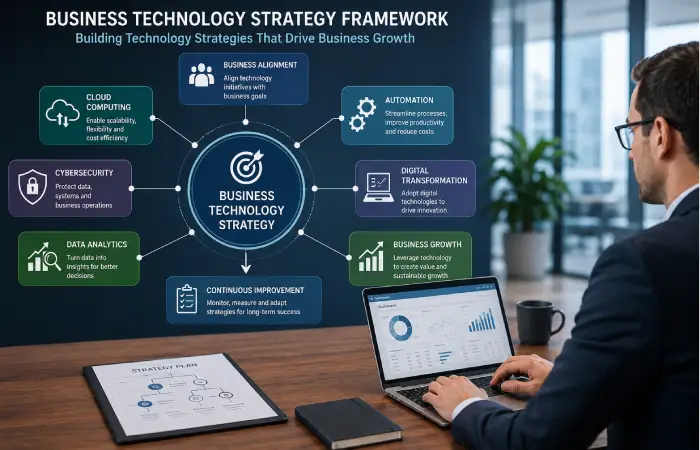
A technology strategy should begin with business requirements rather than software.
Step 1: Identify Business Objectives
Start by asking what the organisation is trying to achieve.
Possible objectives include:
- Reducing operational costs
- Improving customer service
- Increasing productivity
- Supporting remote work
- Improving security
- Expanding into new markets
- Making faster decisions
Technology decisions become easier when these objectives are clearly defined.
Step 2: Review the Existing Technology
Before purchasing new systems, evaluate what is already being used.
Look at:
- Existing software
- Hardware
- Data storage
- Security controls
- Internet infrastructure
- Business processes
- Employee workflows
- Existing technology costs
This can reveal tools that are underused or systems that duplicate the same functions.
Step 3: Identify Technology Gaps
Compare the current environment with the desired future state.
For example:
| Business Need | Current Problem | Potential Solution |
| Collaboration | Files stored across different locations | Centralised cloud workspace |
| Customer management | Customer information spread across spreadsheets | CRM platform |
| Security | Weak account protection | MFA and access controls |
| Reporting | Manual spreadsheets | Automated analytics |
| Repetitive work | Employees perform the same tasks repeatedly | Workflow automation |
This gap analysis creates a more practical technology roadmap.
Step 4: Prioritise Investments
Not every technology problem needs to be solved immediately.
Prioritise projects based on:
- Business impact
- Risk reduction
- Cost
- Implementation complexity
- Employee requirements
- Customer impact
- Compliance requirements
A smaller project that solves an important operational problem may be more valuable than an expensive technology transformation with unclear outcomes.
Step 5: Measure Results
Technology investments should have measurable objectives.
Useful metrics may include:
- Time saved
- Cost reduction
- Error reduction
- Customer response time
- System availability
- Conversion rate
- Employee adoption
- Security incidents
Measuring results helps management determine whether a technology project is actually delivering value.
Business Technology Strategies for Improving Productivity
Technology can improve productivity, but adding more applications does not automatically make employees more productive.
A better approach is to simplify workflows.
For example, instead of asking employees to manually transfer information between multiple systems, businesses can investigate whether those systems can be integrated.
Useful productivity strategies include:
Automate Repetitive Processes
Tasks involving predictable steps are often good candidates for automation.
Examples include:
- Data entry
- Report generation
- Appointment reminders
- Invoice processing
- Email notifications
- Document organisation
Reduce Application Overload
Too many applications can create confusion.
Businesses should periodically review their software environment and identify tools that:
- Perform overlapping functions
- Are rarely used
- Create unnecessary manual work
- Do not integrate with important systems
Create Standard Workflows
Technology works best when employees understand how it should be used.
Documented workflows can help employees know:
- Which system to use
- What information to enter
- Who approves the work
- Where information is stored
- What happens next
Using AI and Automation in Business
AI should be introduced with a clear purpose.
A useful starting point is to identify repetitive processes that consume significant employee time.
For example, a business might discover that employees spend several hours each week summarising internal documents. An AI-assisted workflow could potentially reduce that workload while keeping a person responsible for reviewing important outputs.
AI implementation should consider:
- Data privacy
- Accuracy
- Human oversight
- Security
- Integration
- Cost
- Employee training
- Performance measurement
Current enterprise technology discussions increasingly emphasise the combination of AI capability and trust, particularly as organisations move AI into everyday workflows.
The objective should be useful automation, not automation for its own sake.
Cybersecurity as Part of a Business Technology Strategy
Security should be considered before deploying new technology.
A business technology strategy should identify critical systems and information and determine what could happen if they became unavailable, corrupted or exposed.
Important questions include:
- Which systems are essential to daily operations?
- What customer or business data needs protection?
- Who should have access?
- What happens if an account is compromised?
- How frequently are backups tested?
- How quickly could the business recover from an incident?
NIST describes CSF 2.0 as a flexible framework that can help organisations of different sizes and sectors understand, assess, prioritise and communicate cybersecurity risks.
For smaller organisations, NIST also provides a dedicated CSF 2.0 Small Business Quick-Start Guide.
How Cloud Technology Supports Business Growth
Cloud technology can support growth by providing access to scalable infrastructure and services.
Instead of purchasing infrastructure for the maximum expected future workload, businesses can often adjust cloud resources as requirements change.
Potential advantages include:
- Flexible capacity
- Remote accessibility
- Centralised management
- Easier collaboration
- Disaster recovery options
- Access to modern software services
However, cloud adoption should still involve proper planning.
Businesses should review:
- Data residency requirements
- Vendor security
- Backup arrangements
- Service availability
- Access controls
- Integration requirements
- Long-term pricing
Cloud technology is a business decision, not simply an IT decision.
Common Technology Mistakes Businesses Should Avoid
Choosing Technology Before Defining the Problem
A business should identify the problem first and then evaluate possible solutions.
Ignoring Employee Adoption
Even an excellent system can fail if employees find it difficult to use or do not understand its purpose.
Training and communication should therefore be part of implementation.
Buying Too Many Tools
More software does not necessarily mean better technology. A fragmented technology environment can increase costs and create unnecessary complexity.
Treating Security as an Afterthought
Security should be built into technology planning from the beginning.
Failing to Measure ROI
Businesses should define what success looks like before investing heavily in a new technology.
Neglecting Data Quality
AI and analytics systems depend heavily on the quality of the information they receive. Poor or inconsistent data can produce unreliable results.
How to Choose the Right Technology Solutions
When evaluating a business technology solution, consider the following questions:
Does it solve a real business problem?
If the connection between the technology and business objective is unclear, the investment deserves closer examination.
Can it integrate with existing systems?
Integration can reduce duplicate data entry and fragmented workflows.
Is it secure?
Review authentication, encryption, permissions, monitoring, backups and vendor security practices.
Can employees use it effectively?
Consider usability, training requirements and accessibility.
Can it scale?
The solution should be capable of supporting expected business growth without requiring a complete replacement.
What is the total cost?
Look beyond the initial purchase price. Include subscriptions, implementation, training, maintenance, integrations and support.
The Future of Business Technology
Business technology is moving towards more connected and intelligent systems.
AI is becoming integrated into productivity applications, customer service, analytics and business workflows. Cloud platforms continue to support distributed operations, while cybersecurity and governance are becoming increasingly important as businesses depend on more digital systems.
The future is therefore unlikely to be about adopting one particular technology.
Instead, successful organisations will increasingly focus on connecting people, processes, data and technology around measurable business objectives.
This means technology leaders and business managers need to work together rather than treating technology as a separate department.
Frequently Asked Questions
What are business technology solutions?
Business technology solutions are digital tools, systems and services that help organisations manage operations, employees, customers, data, security and other business activities.
What is a business technology strategy?
A business technology strategy is a structured plan for selecting, implementing and managing technology in support of an organisation’s objectives.
What are the most important business technologies?
Commonly important areas include cloud computing, cybersecurity, AI, automation, CRM, data analytics and digital collaboration tools. The right priorities depend on the organisation’s specific requirements.
How can technology improve business productivity?
Technology can improve productivity by automating repetitive tasks, simplifying workflows, improving collaboration and giving employees faster access to useful information.
Why is cybersecurity important for business technology?
Modern businesses depend on digital systems and data. Cybersecurity helps organisations reduce the risk of unauthorised access, data loss, disruption and other technology-related threats.
Should small businesses invest in business technology?
Yes, but investments should be based on actual business needs. Small businesses can start with practical solutions such as secure cloud services, accounting software, collaboration tools, customer management systems and basic cybersecurity controls.
Conclusion
The best business technology solutions and strategies are not necessarily the newest or most expensive ones. They are the solutions that address genuine business problems and produce measurable improvements.
A strong approach begins with business objectives, reviews existing technology, identifies gaps, prioritises investments and measures results. Cloud computing, AI, automation, cybersecurity, CRM and analytics can all play an important role when they are implemented with a clear purpose.
As technology continues to evolve, businesses should focus on building a flexible digital foundation rather than chasing every new trend. The organisations most likely to benefit from technology are those that combine innovation with security, employee adoption, responsible governance and measurable business outcomes.
