
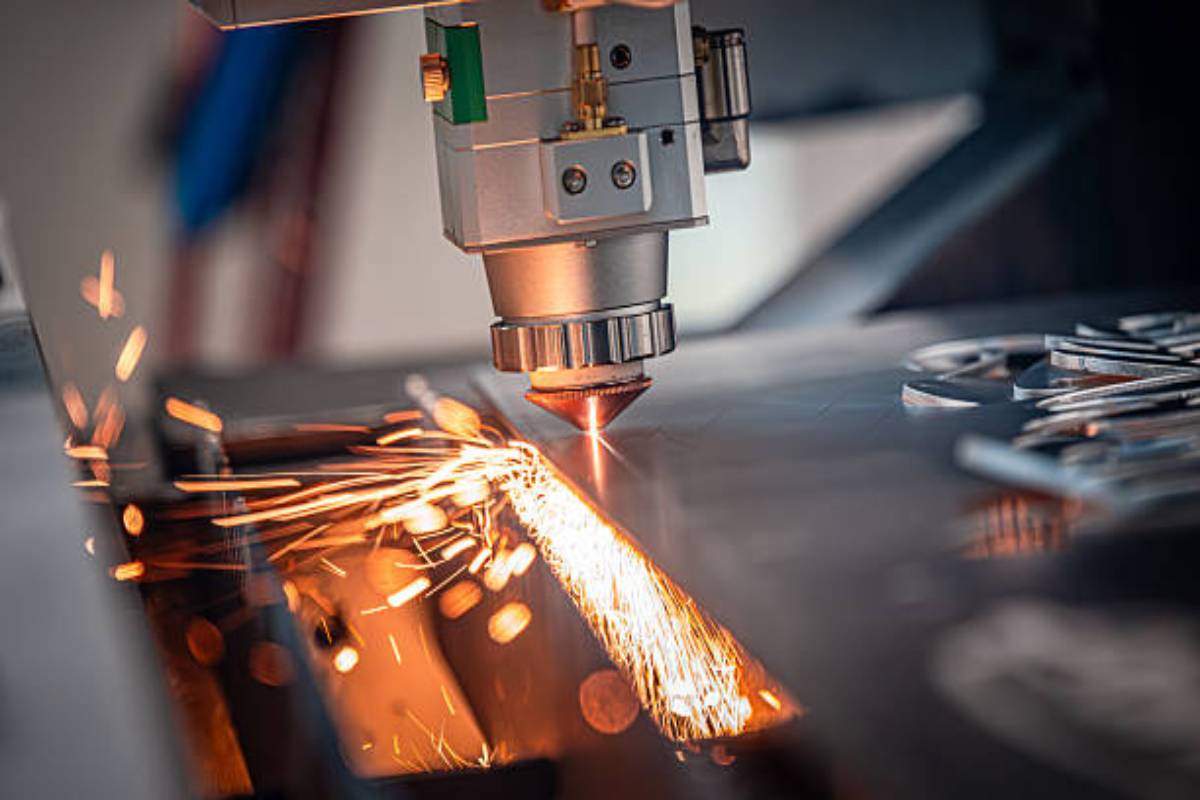
Precision CNC machining operates on tolerances measured in microns. A contaminated spindle taper, a coolant-fouled fixture, or an oxidized clamping surface can translate directly into rejected parts, tool crashes, or repeated setups. The cleaning methods most shops rely on — aerosol solvents, abrasive pads, compressed air — were designed for a different era of manufacturing. They work well enough in many situations, but they introduce variables that precision operations cannot always afford.
Laser cleaning is gaining traction in CNC environments precisely because it removes that variability. It is a non-contact, non-abrasive process with repeatable results — exactly the kind of process characteristic that fits naturally into a shop already running tight tolerances and documented procedures.
Table of Contents
The Core Problem: Contamination in CNC Environments
CNC machining generates contamination constantly. Coolant residue coats fixtures, vises, and chuck jaws after every wet-cutting operation. Oxidation forms on steel and aluminum surfaces left sitting between jobs. Chip buildup, cutting oil films, and polymer deposits from coated tools accumulate on spindle interfaces and tool holders over time.
Each of these contamination types creates a specific risk. Coolant film on a fixture jaw changes the effective clamping force. Oxide on a reference surface shifts the datum. Built-up chips in a tool holder taper affect runout. These are not catastrophic failures in most cases — they are the quiet contributors to the few-micron errors that separate a good setup from a great one.
Traditional cleaning methods address some of these problems but introduce their own complications. Solvent wiping can redistribute contamination rather than remove it. Abrasive pads leave microscopic scratches on precision reference surfaces. Compressed air moves debris but does not remove it. Ultrasonic cleaning is effective but requires disassembly and a wet cleaning cycle that adds cycle time and drying requirements.
How Laser Cleaning Works in a CNC Context
Laser cleaning uses a focused, pulsed laser beam to ablate contamination from a surface. The contaminant — whether it is coolant residue, oxide, grease, or polymer deposit — absorbs the laser energy and is vaporized or ejected from the base material. The substrate itself reflects the wavelength at the energy levels used for cleaning, so the base material is not affected when the process parameters are set correctly.
For CNC applications, this selectivity matters for two reasons. First, it means the process can be applied to finished precision surfaces without dimensional risk. A tool holder taper can be cleaned without touching the ground surface geometry. A fixture jaw can be cleaned in place without removing it from the vise. Second, the process leaves no residue — no solvent film, no abrasive particles, no moisture — which is important for surfaces that will be immediately used as datums or seating surfaces.
The equipment used in shop environments is typically a handheld or gantry-mounted scan head connected to a fiber laser source. Output power for CNC cleaning applications generally falls in the 50–200W range, which is sufficient for surface contamination removal without the infrastructure demands of higher-power systems used in heavy industrial descaling.
Specific Applications in CNC Shops
Tool Holder and Spindle Taper Maintenance
CAT, BT, and HSK spindle interfaces are ground to precise tolerances, and their performance depends on clean metal-to-metal contact. Coolant contamination, microscopic chip fragments, and fretting corrosion from repeated tool changes accumulate in both the holder taper and the spindle bore over time. The result is increased runout, reduced clamping force, and in severe cases, tool pull-out during heavy cuts.
Laser cleaning removes these deposits from taper surfaces without touching the ground geometry. The process takes seconds per tool holder and can be incorporated into a routine maintenance schedule rather than waiting for measurable runout problems to develop.
Fixture and Workholding Component Cleaning
Precision fixtures — particularly those used for multi-part setups or palletized machining — accumulate coolant film, chip deposits, and surface oxidation across production runs. A contaminated locating pin or seating pad introduces positioning error that is often attributed to other causes before the fixturing is examined.
Laser cleaning is well-suited to fixture maintenance because it can be applied selectively to seating surfaces, locating features, and clamping faces without requiring the fixture to be disassembled or removed from the machine. Shops running dedicated fixturing for repeat jobs can treat fixture cleaning as a scheduled PM item rather than a reactive response to part rejection.
Pre-Inspection Surface Preparation
Coordinate measuring machine (CMM) inspection and surface plate measurement both require clean reference surfaces. Coolant film or oxide on a part surface can affect probe contact and introduce measurement error. Laser cleaning provides a rapid, residue-free method to prepare part surfaces before inspection without introducing the wiping variables of cloth or solvent application.
Rust and Oxide Removal on Tooling and Fixtures
Steel tooling, vise jaws, angle plates, and other shop equipment develop surface rust during storage or in humid environments. Light surface rust does not always compromise function, but it does affect dimensional stability of clamping surfaces and can transfer contamination to workpieces. Laser cleaning removes surface oxide from steel components without material removal, restoring the surface without the dimensional risk of abrasive methods.
Process Integration and Practical Considerations
One of the practical advantages of laser cleaning in a CNC environment is that it does not require a dedicated cleaning station or process line. A portable unit can be brought to the machine or fixturing rather than requiring components to be transported to a cleaning area. This matters in job shops and low-volume precision environments where flexibility and minimal handling are priorities.
The learning curve for operators is moderate. Setting correct parameters — power, pulse frequency, scan speed — for different materials and contamination types requires some initial testing and documentation. Once the parameters are established for a shop’s common applications, day-to-day operation is straightforward. Many shops develop a simple parameter card for their most frequent cleaning tasks, similar to how cutting parameters are documented for recurring operations.
Fume extraction is required. Vaporized contamination from the ablation process must be captured, and a filtered extraction unit is standard with commercial laser cleaning systems. In a shop environment where coolant mist collectors and dust extraction are already in use, adding a laser cleaning extraction unit is a familiar type of installation.
For shops evaluating this technology, working with a qualified laser cleaning machine supplier who can provide application testing on your specific tooling and fixture materials is the most efficient path to implementation. Cleaning results depend on the interaction between laser parameters and the specific contaminant and substrate combination, and a supplier who can run tests on your actual components will give you realistic expectations before you commit to equipment.
Measuring the Impact
Shops that have adopted laser cleaning for tooling and fixture maintenance typically report benefits in three areas: part quality consistency, maintenance labor, and consumable costs.
Part quality consistency improves because the sources of quiet contamination error are systematically addressed rather than managed reactively. Setups that previously required repeated tweaking stabilize more quickly when fixturing and tool holders are consistently clean.
Maintenance labor shifts from reactive cleaning in response to problems — a tool change after unusual runout, a re-setup after a datum check fails — toward scheduled preventive maintenance that takes less time per event and produces more predictable outcomes.
Consumable costs related to solvent, abrasive pads, and cleaning supplies decrease. The laser system itself has minimal ongoing consumables — primarily fume extraction filters — and does not require replenishment of chemical cleaning agents.
Is It Right for Your Shop?
Laser cleaning is not the answer to every cleaning challenge in a CNC environment, but it addresses a specific set of problems particularly well: precision surface cleaning where residue and dimensional risk from conventional methods create real process issues.
If your shop runs close-tolerance work, uses dedicated fixturing, or struggles with the consistency of manual cleaning methods, the technology is worth a closer look. The entry point in terms of equipment cost has dropped substantially as the technology has matured, and the ROI case is straightforward for shops where a single rejected part or unplanned setup represents significant cost.
The right starting point is identifying your two or three highest-frequency cleaning tasks where either quality risk or labor time is the primary concern, then requesting a demonstration using actual components from your production environment. Results on real parts tell you more than general specifications, and a supplier experienced with industrial laser cleaners for precision manufacturing will be able to run those tests and give you the data you need to make the decision.
Precision machining is fundamentally about controlling variables. Laser cleaning is, at its core, a way to remove one category of variable — surface contamination — from the equation in a more controlled and repeatable way than the methods it replaces. For shops where that matters, the fit is a natural one.
