
There’s a big difference between knowing some C# and feeling confident building real systems.
If you’re early in your .NET journey, you’ve probably experienced this:
- You can write classes
- You understand async/await
- You’ve followed a few tutorials.
But if someone said, “Build a production-ready API,” you’d hesitate.
That hesitation is normal. Confidence in software engineering doesn’t come from watching more videos. It comes from building things that stretch you, and surviving the process.
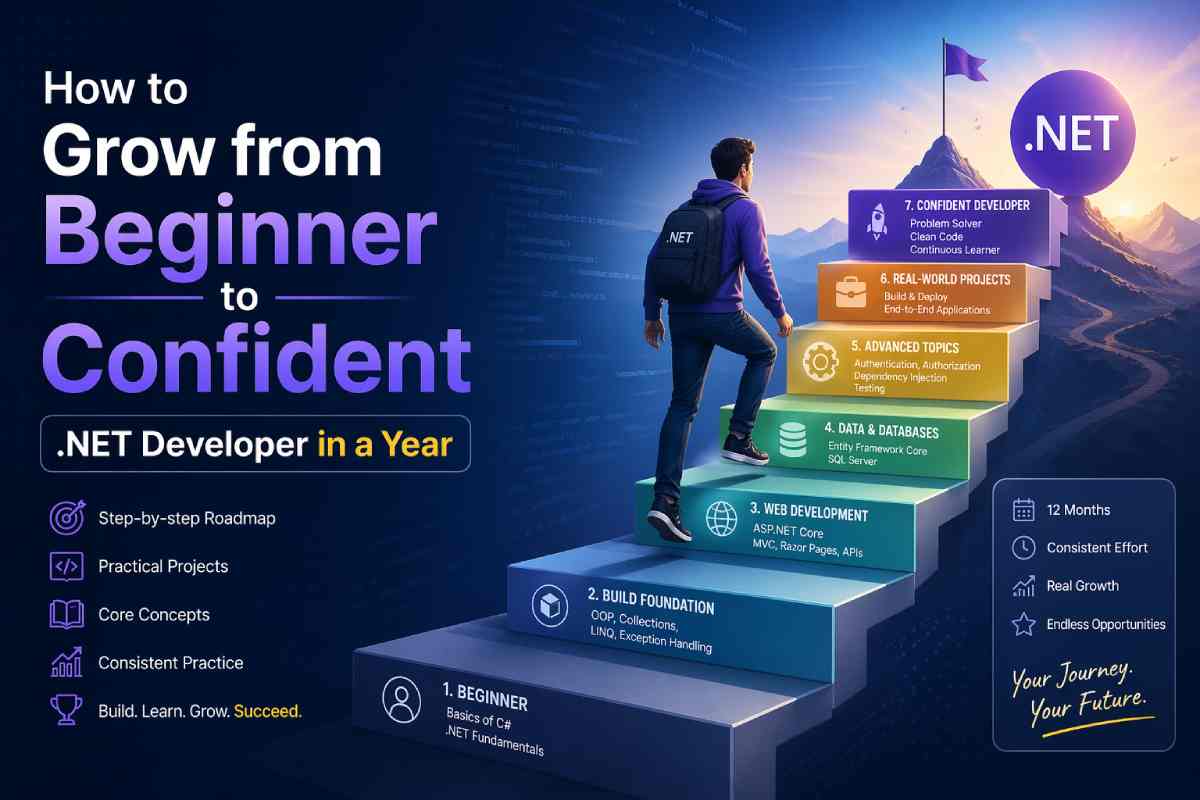
The good news? With a focused plan, one year is more than enough to move from beginner to confident .NET developer.
Here’s a practical roadmap to get you there.
Table of Contents
First, What Does ‘Confident’ Actually Mean?
Before we talk about timelines, let’s define the goal.
A confident .NET developer:
- Can design and build a Web API without copying everything from a tutorial
- Understands how data flows through an application
- Can debug issues without panicking
- Knows when to use certain patterns, and when not to
- Understands trade-offs instead of chasing “perfect architecture.”
With that in mind, here’s how to structure your year.
Months 1–3: Build a Strong C# Foundation
The first three months are about depth, not speed.
A lot of beginners rush into ASP.NET before they truly understand C#. That usually backfires.
Focus on:
- Types, generics, collections
- LINQ and data manipulation
- Exception handling
- Async/await and tasks
- Object-oriented principles
- Basic unit testing.
Don’t just read about these concepts, write small programs that force you to use them.
Build:
- A console-based task tracker
- A small library for parsing files
- A basic in-memory caching system.
The goal here isn’t to build impressive apps. It’s to become comfortable with the language, so you stop fighting syntax and start thinking about design.
Months 4–6: Enter ASP.NET Core (The Right Way)
Now you’re ready for web development.
Most people start with:
- Controller
- Repository
- Database
That’s fine, but go deeper. During this phase, build a real Web API that includes:
- Input validation
- Proper error handling
- Authentication
- Logging
- Configuration management
- Environment-based settings.
You’ll quickly realize that building APIs is less about controllers and more about decisions.
Where does business logic live?
How do you structure your solution?
How do you handle failures?
This is where patterns like Clean Architecture or Vertical Slice Architecture start to make sense.
Months 7–9: Build Systems That Feel Real
Now it’s time to stop building isolated features and start building systems.
At this stage, you should tackle projects that introduce real-world complexity.
Examples:
1. A Modular Monolith
Before jumping to microservices, build a well-structured modular monolith.
Learn how to:
- Create boundaries between modules
- Avoid circular dependencies
- Structure large solutions
- Keep features isolated.
Understanding this will make you far stronger than someone who jumped straight to distributed systems without discipline.
2. Background Workers
Build a background processing system.
Add:
- Queue processing
- Retry policies
- Idempotency
- Graceful shutdown.
Background systems teach you something important: failure happens in weird ways. Learning to design for it is what separates junior from mid-level developers.
3. External Integrations
Integrate your application with:
- A third-party API
- A payment provider (mocked is fine)
- An email service.
You’ll learn about:
- Timeouts
- Circuit breakers
- Defensive programming
- Reliability patterns.
This is where “clean” designs start to bend, and you learn to adapt.
Months 10–12: Think like an Engineer
This is the phase where confidence really forms.
Now that you’ve built several projects, revisit them. Refactor them. Improve them. Add features and see what breaks.
Here’s what to focus on:
Observability
Add:
- Structured logging
- Correlation IDs
- Metrics
- Health checks.
Try to debug issues without attaching a debugger. This is a superpower in production systems.
Security
Go beyond basic authentication.
Learn:
- Policy-based authorization
- Role-based access
- Secure secret handling
- Token flows.
Security shortcuts often look harmless — until they aren’t.
Testing
Strengthen:
- Unit tests
- Integration tests
- Testable architecture.
Testing isn’t about coverage percentages. It’s about confidence when refactoring.
The Secret: Build Fewer Projects, Go Deeper
Many beginners make the mistake of building 20 shallow projects.
A better strategy? Build 3–5 serious projects and evolve them over time.
Add:
- New features
- Better logging
- Improved architecture
- Performance optimizations.
Watch how your early design decisions age. That experience is worth more than another tutorial.
How to Structure Your Learning Week
Consistency beats intensity.
A realistic weekly rhythm:
- 3–4 focused coding sessions (60–90 minutes each)
- 1 session reviewing concepts
- 1 session refactoring or improving existing code.
Avoid binge-learning on weekends and doing nothing during the week. Treat it like training, not entertainment.
Where Structured Learning Helps
You can do all this alone. Many developers do.
But one thing that accelerates growth significantly is structured guidance, especially when you’re not yet experienced enough to know what “good” looks like.
Hands-on courses that mirror real production scenarios can shorten the feedback loop dramatically. Instead of guessing whether your architecture makes sense, you can compare it to experienced engineers’ approaches.
Platforms like Dometrain, for example, focus heavily on real-world .NET projects rather than slide-based theory. Their learning paths move from C# fundamentals through practical .NET capabilities and into modern architectural patterns, which align closely with the year-long roadmap outlined above.
The key isn’t the platform itself. It’s the emphasis on building real systems, not just watching someone else code.
Common Mistakes to Avoid
Let’s save you some pain.
1. Chasing Trends Too Early
Don’t start with microservices, Kubernetes, or event sourcing. Master fundamentals first.
2. Copy-Paste Development
If you don’t understand it, don’t paste it. Struggle a little. That’s where learning happens.
3. Avoiding Hard Problems
If something feels confusing, that’s a signal, not a stop sign. Dig into it.
4. Jumping Between Languages
Stick to .NET for the year. Depth builds confidence.
What Confidence Feels Like After a Year
If you follow this roadmap consistently, here’s what changes:
- You won’t freeze when asked to build an API.
- You won’t panic when something breaks.
- You’ll understand trade-offs.
- You’ll design with intention.
You won’t know everything, no one does, but you’ll trust yourself to figure things out. That’s confidence.
Final Thoughts
Growing from beginner to confident .NET developer in a year isn’t about grinding 12 hours a day. It’s about deliberate practice, real projects, and steadily increasing complexity.
- Start with C#.
- Move into real APIs.
- Build systems.
- Refactor them.
- Add observability and security.
If you focus on building instead of consuming, one year is more than enough to transform how you think about software.
And once you start thinking like an engineer instead of a tutorial follower, that’s when everything changes.
