
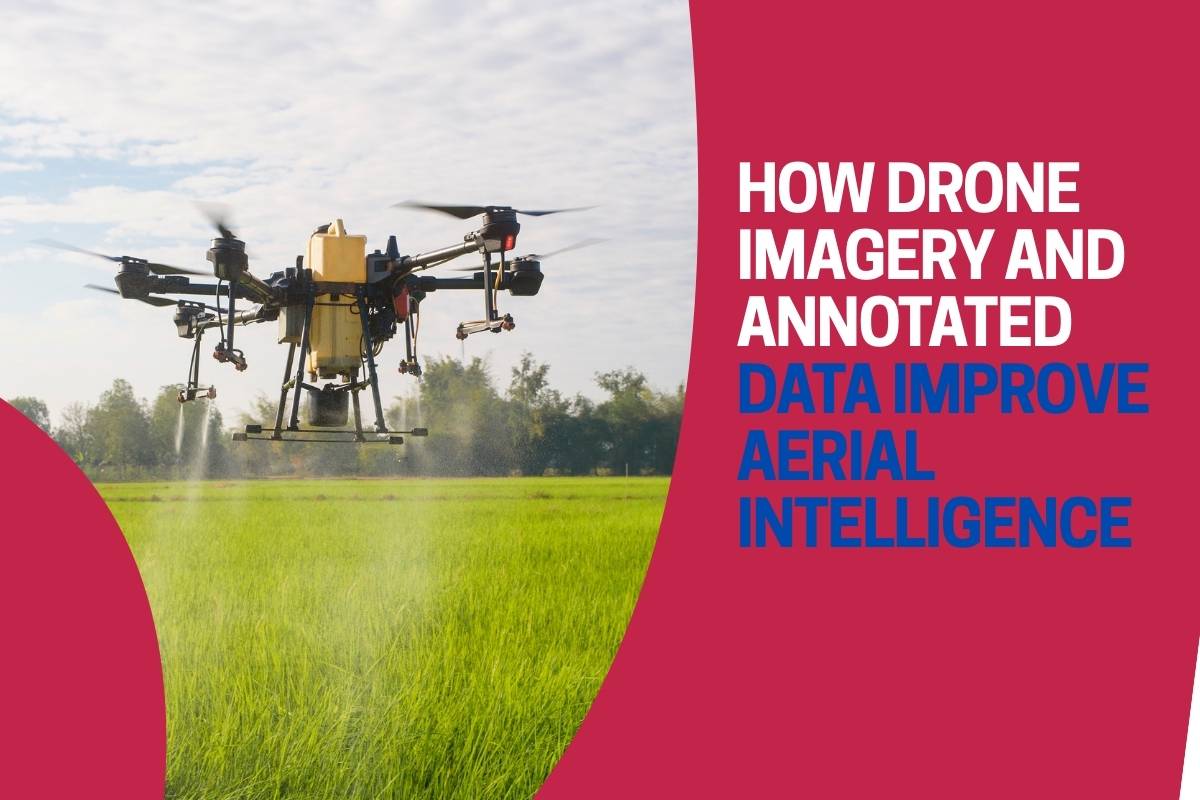
Drones have become a critical tool for collecting visual data across a wide range of industries. From infrastructure inspection and environmental monitoring to agriculture, mapping, and security, aerial imagery provides perspectives that were previously difficult or expensive to obtain. However, raw drone imagery alone does not deliver actionable intelligence. The true value of aerial data emerges when it is structured, annotated, and transformed into inputs that artificial intelligence systems can understand, that is drone image annotation.
As organizations increasingly rely on drones for operational decision-making, annotated data has become a central component of aerial intelligence. Without structured training data, even high-resolution imagery and advanced AI models fail to deliver reliable insights at scale.
Table of Contents
The growing role of drones in data-driven operations
Drone technology has advanced rapidly in recent years. Improvements in camera sensors, flight stability, battery life, and onboard processing have enabled drones to capture large volumes of detailed visual data efficiently. This has led to widespread adoption across sectors such as construction, energy, agriculture, urban planning, and emergency response.
Yet as drone deployments scale, organizations face a common challenge. Vast quantities of imagery are collected, but only a fraction of it can be analyzed manually. AI systems are therefore essential for extracting patterns, detecting objects, and identifying changes over time. The effectiveness of these systems depends heavily on the quality of the data used to train them.
Why raw drone imagery is not enough
Drone imagery is inherently complex. Images may vary significantly due to altitude, camera angle, lighting conditions, weather, and motion blur. Objects of interest can appear at different scales and orientations, and backgrounds are often cluttered or dynamic.
Without annotation, AI models cannot reliably distinguish meaningful features from noise. Data annotation provides the structure needed to guide learning by identifying relevant objects, regions, or patterns within images. This process enables models to associate visual cues with specific classes or behaviors.
In aerial contexts, even small annotation errors can have significant downstream effects. Mislabeling objects or inconsistently defining boundaries can lead to false detections or missed events, reducing the usefulness of AI-driven analysis.
The importance of annotation in aerial intelligence systems
Data annotation transforms raw drone imagery into structured training datasets. Depending on the use case, this may involve bounding boxes, segmentation masks, classifications, or temporal labels across image sequences.
Common annotation tasks in drone imagery
Drone-based applications often rely on several annotation techniques:
- Object detection, used to locate vehicles, people, infrastructure elements, or vegetation
- Semantic segmentation, which assigns class labels to every pixel for detailed scene understanding
- Instance segmentation, which distinguishes individual objects within the same class
- Change detection, where annotations highlight differences between images captured at different times
Each of these tasks requires precise and consistent labeling to ensure that models learn reliable patterns.
Annotation challenges specific to aerial data
Aerial imagery presents unique challenges that are less common in ground-level computer vision. Objects may appear very small relative to the overall image, partially occluded, or visually similar to their surroundings. Scale variation is significant, and class boundaries can be ambiguous.
To address these challenges, annotation workflows must be carefully designed. Guidelines should define how to handle occlusions, overlapping objects, and uncertain cases. Quality control processes are essential to maintain consistency across large datasets.
From annotated imagery to actionable intelligence
When drone imagery is properly annotated, AI systems can extract insights that go far beyond basic visualization. Annotated datasets enable models to detect patterns, quantify changes, and support predictive analysis.
Examples of aerial intelligence applications include:
- Monitoring infrastructure for damage or wear
- Detecting unauthorized activity or safety risks
- Tracking environmental changes over time
- Optimizing agricultural practices through crop analysis
- Supporting urban planning and land use management
In each case, the reliability of AI outputs depends on the quality of the annotated data used during training.
Object recognition as a foundation for drone-based AI
One of the most common tasks in aerial intelligence is object recognition. Models must identify and classify objects accurately under varying conditions. This requires training data that reflects real-world complexity and variability.
Understanding how drone object recognition works highlights the importance of consistent annotation. Models learn object characteristics from labeled examples, including shape, texture, context, and spatial relationships. Inconsistent labeling can confuse models and reduce detection accuracy.
Well-annotated datasets enable models to generalize across environments, making them more robust when deployed in new locations or conditions.
Scaling drone AI systems requires structured data pipelines
As drone programs grow, annotation must scale alongside data collection. Manual, ad-hoc labeling approaches quickly become bottlenecks. Organizations need structured pipelines that support continuous data ingestion, annotation, review, and dataset versioning.
Key components of scalable annotation workflows
Effective aerial data pipelines typically include:
- Standardized annotation guidelines aligned with operational goals
- Multi-stage review processes to ensure accuracy and consistency
- Sampling strategies to identify and correct systematic errors
- Dataset versioning to track changes over time
- Feedback loops between model performance and data refinement
These components help ensure that datasets remain relevant and reliable as AI systems evolve.
From prototype to production in drone intelligence
Many drone AI projects perform well during initial testing but struggle in real-world deployment. This transition often reveals weaknesses in training data, such as insufficient coverage of edge cases or outdated annotations.
Organizations that succeed in deploying drone intelligence systems treat data annotation as an ongoing process rather than a one-time task. Continuous improvement of training datasets allows models to adapt to new conditions and maintain performance over time.
Specialized partners such as DataVLab support teams working with aerial imagery by delivering high-quality annotated datasets tailored to drone-based computer vision applications. Structured annotation workflows and quality control processes help organizations reduce operational risk and accelerate deployment.
Data quality as a strategic asset in aerial intelligence
As aerial intelligence becomes more central to decision-making, data quality takes on strategic importance. Reliable annotated datasets enable organizations to trust AI outputs and integrate them into operational workflows.
Investing in data annotation early reduces long-term costs by minimizing rework and improving model stability. Teams can iterate faster, respond to new requirements more effectively, and deploy AI systems with greater confidence.
Conclusion: annotated data unlocks the value of drone imagery
Drone imagery offers unprecedented access to visual information, but its value depends on how effectively it is transformed into actionable intelligence. Data annotation provides the structure needed for AI systems to interpret aerial data accurately and consistently.
By investing in structured annotation workflows, clear standards, and quality control, organizations can unlock the full potential of drone-based AI. Annotated data is not an optional enhancement. It is the foundation that enables scalable, reliable, and intelligent aerial analysis.
