
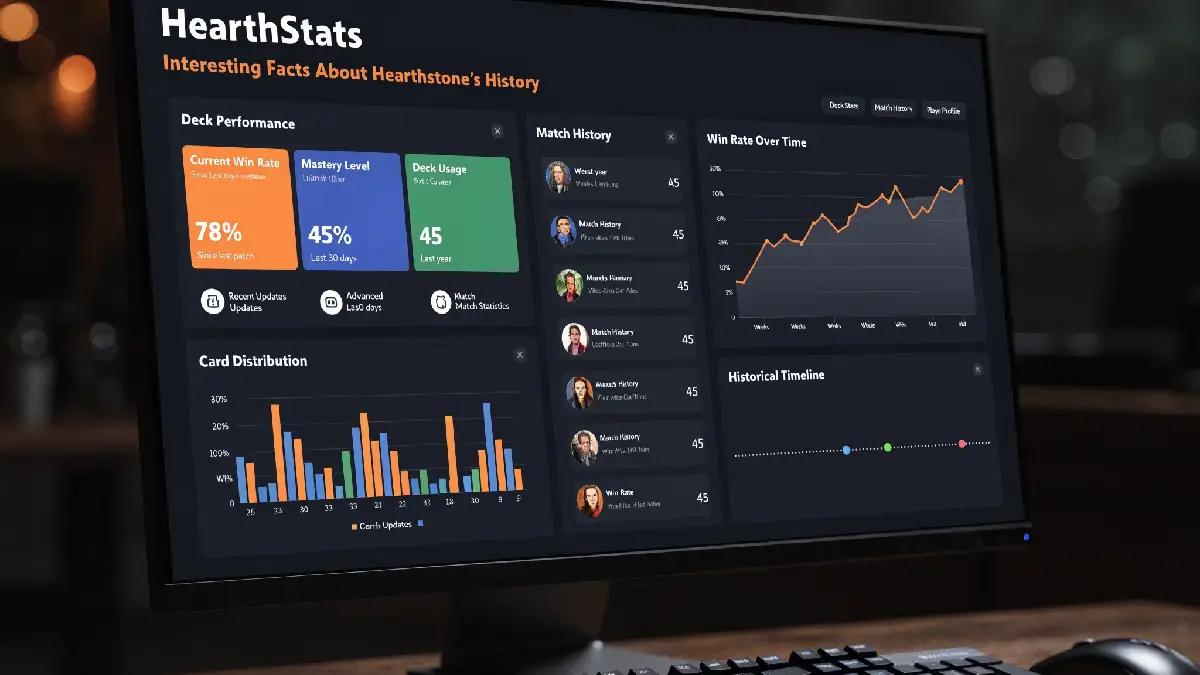
Searching for HearthStats interesting facts can lead you down a surprisingly complicated path. It rings Hearthstone stats and community monitoring, and today I’ve received websites, too, using a comparable brand name to contain gambling/gaming/technology/interesting facts-
What I require would then be not just a random, trivia-based definition but I’d expect the explanation of HearthStats to clarify: What is HearthStats/why are stats so important to HS players, which of those alleged ‘facts’ can be authenticated and how can I keep those stats, that appear out of thin air, from appearing anywhere.
Table of Contents
What Is HearthStats?

HearthStats is best understood in the context of Hearthstone statistics and match tracking.
The original concept was built around a straightforward problem: players wanted to know more about their own games than the basic information shown inside the game client.
Instead of relying entirely on memory, players could use statistics to examine questions such as:
- How often am I winning with a particular deck?
- Which opposing classes cause the most problems?
- Is a deck performing consistently?
- How does my performance change over time?
- Are my results improving after changing a deck?
This type of information is valuable because individual Hearthstone sessions can be misleading.
A player might win five games in a row and believe a deck is excellent. A larger sample might tell a different story.
An Important Name-Checking Point
The HearthStats name should not automatically be treated as one current, unified platform.
A website currently operating at hearthstats.net presents itself as a broad publishing site with categories including Gaming, Consoles, Cool Things and Interesting Facts. Its current content is much broader than a dedicated Hearthstone statistics tracker.
That is different from the historical idea of HearthStats as a specialised Hearthstone statistics service.
This distinction is one of the most important facts to understand before researching the keyword.
HearthStats Interesting Facts You Should Know
Here are some of the more useful and verifiable facts surrounding HearthStats and the wider Hearthstone statistics ecosystem.
1. Hearthstone Has Been Around for More Than a Decade
Hearthstone officially launched in March 2014.
Blizzard marked the game’s 10th anniversary in 2024, confirming that the game had reached a decade of continuous development.
That longevity is important when considering statistics websites.
A tracker designed for Hearthstone in its early years was operating in a very different environment from one designed today. Card pools, game modes, ranking systems and data-analysis expectations have changed considerably.
2. Hearthstone Reached 20 Million Players Very Early
One of Blizzard’s early milestones came in September 2014, when the company announced that more than 20 million players had entered Hearthstone’s virtual tavern.
Blizzard even turned the milestone into a piece of game trivia, noting that Illidan had been defeated more than 100,000 times per day on average since launch.
This is a good example of why official historical announcements are preferable to unattributed statistics copied between websites.
3. Hearthstone Later Passed 100 Million Registered Players
In November 2018, Blizzard announced that Hearthstone had welcomed more than 100 million players.
However, there is an important distinction here:
100 million registered players does not mean 100 million active players at the same time.
Registered-player milestones represent the number of accounts or players accumulated over a period. They should not be interpreted as a real-time active-user figure.
This distinction is especially important when reading gaming statistics.
4. Statistics Can Tell a Different Story from Personal Experience
One of the most interesting reasons for using a statistics tracker is the difference between perception and evidence.
Imagine a player uses a deck for ten matches:
| Result | Example |
| Wins | 7 |
| Losses | 3 |
| Win rate | 70% |
A 70% win rate looks excellent.
But ten games is a small sample. If the player tracks 200 games, the result may move substantially.
This is why experienced players should consider:
- Sample size
- Rank
- Game mode
- Patch version
- Opponent class
- Deck list
- Date range
A statistic without context can easily become misleading.
How Hearthstone Statistics Became Useful
Statistics became particularly useful as Hearthstone developed a larger competitive ecosystem.
Players no longer needed only to ask, “Did I win?”
They could ask more detailed questions:
Which deck performs best for me?
Which match-ups are causing losses?
Does a card change improve my results?
Is my performance actually improving?
This turns gameplay into a feedback loop.
The Basic Statistics Workflow
A simple tracking workflow looks like this:
Play games → Record results → Organise data → Calculate performance → Identify patterns → Test changes → Reassess
This is the central reason statistics tools can be useful.
The tool does not magically make a player better. Instead, it gives the player information that can support better decisions.
HearthStats vs a Typical Hearthstone Statistics Tool
The terminology can be confusing, so it helps to compare the concept with a typical modern game-statistics platform.
| Feature | Historical HearthStats-style tracking | Modern statistics platform |
| Match recording | Core purpose | Usually supported |
| Deck performance | Important | Usually detailed |
| Match-up analysis | Useful | Often highly developed |
| Automated collection | More limited historically | Common in modern tools |
| Meta analysis | More community-focused | Often based on larger datasets |
| Historical value | High | Depends on platform |
| Current game compatibility | Requires maintenance | Must be actively updated |
| Best use | Personal and historical analysis | Current competitive analysis |
The biggest difference is scale and automation.
Modern tools can potentially process much larger datasets, while older community trackers were often designed around personal record keeping.
Interesting Hearthstone Statistics Are Not Always HearthStats Statistics
This is another distinction worth making.
When someone searches for “Hearth Stats interesting facts”, they may expect facts specifically about the Hearth Stats platform.
Instead, many articles use the keyword to discuss broader Hearthstone trivia.
That can include:
- Player milestones
- Card statistics
- Historical expansions
- Game mechanics
- Competitive records
- Deck performance
- Ranking systems
- Developer decisions
- Technical quirks
There is nothing wrong with discussing those subjects, but the article should clearly identify whether a number describes HearthStats itself or Hearthstone generally.
The 10-Year Anniversary Produced Some Fascinating Data Features
Hearthstone’s 10-year anniversary was not just a celebration.
Blizzard also introduced an unusual in-client replay feature with Patch 29.0. The company said that players would be shown a replay covering the Hearthstone games they had played.
That is particularly interesting from a statistics perspective because it demonstrates how a player’s accumulated game history can become part of the experience itself.
The anniversary also highlighted how much Hearthstone had changed since its 2014 launch.
Blizzard described 2024 as the game’s 10th year and noted the expansion of Hearthstone into a broad range of game modes.
Why Patch Dates Matter When Reading Hearthstone Statistics
One of the easiest mistakes in gaming research is comparing statistics from different patches as if they were produced under identical conditions.
Hearthstone changes regularly.
For example, Blizzard’s 2026 patch history includes balance updates, Arena changes, Battlegrounds changes, new events and other gameplay adjustments.
The August 2026 Patch 36.4 update introduced new Class Sets, a new Arena season, an event and other changes.
That means a deck’s historical win rate should not automatically be treated as its current win rate.
A Better Way to Read a Statistic
Before trusting a Hearthstone statistic, ask:
- When was it measured?
- Which patch was active?
- Which format was used?
- How many games were included?
- Which ranks were represented?
- Was the data collected automatically or manually?
These questions add context that a simple percentage cannot provide.
What Makes a Good Hearthstone Statistics Platform?
Whether you are evaluating HearthStats or another statistics service, look for several practical features.
Clear Data
The platform should explain what its statistics represent.
For example, “60% win rate” is much less useful than:
60%-win rate across 2,000 Standard games at Diamond rank during a specified patch.
The second version provides context.
Useful Filters
A serious statistics tool should ideally allow users to narrow data by factors such as:
- Format
- Rank
- Class
- Deck
- Patch
- Time period
- Match-up
Current Support
A statistics platform can become outdated quickly.
If a game changes its cards, rules or APIs, an old tracker may stop providing meaningful information.
Transparent Methodology
Good data tools should make it reasonably clear how information is collected.
That helps users understand both the strengths and limitations of the dataset.
Pros and Limitations of HearthStats-Style Tracking
Pros
- Turns gameplay into measurable data
- Helps identify recurring weaknesses
- Makes deck comparisons easier
- Can reveal trends that personal memory misses
- Useful for competitive experimentation
- Creates a historical record of gameplay
Limitations
- Statistics do not guarantee better results
- Small datasets can produce misleading percentages
- Old statistics may no longer represent the current meta
- Different platforms may collect different samples
- Automated tracking may miss certain data
- A high win rate does not necessarily explain why a deck works
The last point is especially important.
Statistics can show what happened. They do not always explain why it happened.
Who Can Benefit from HearthStats-Style Data?
Casual Players
Casual players can use statistics simply to understand their own habits.
For example, you may discover that you perform much better with one class than another.
Returning Players
Statistics can help returning players understand how their results change after learning a new deck or adapting to a new format.
Competitive Players
Competitive players can use larger datasets to investigate:
- Match-up weaknesses
- Deck consistency
- Card choices
- Performance by rank
- Meta changes
However, competitive players should pay particularly close attention to sample size and patch context.
Content Creators
Gaming writers and creators can use statistics to add evidence to deck guides and meta discussions.
The key requirement is attribution.
If a statistic comes from a third-party tracker, identify the tracker and explain the relevant timeframe.
A Simple Workflow for Researching HearthStats Interesting Facts
If you are researching the keyword for a gaming article, use this process.
Step 1: Identify the Claim
Write down the exact fact you want to verify.
For example:
“Hearthstone reached 100 million players.”
Step 2: Find the Primary Source
Search for an official Blizzard announcement.
Blizzard itself confirmed the 100-million-player milestone in 2018.
Step 3: Check the Date
A historical milestone should remain labelled as historical.
Do not turn an old player milestone into a claim about today’s active player base.
Step 4: Separate Platform Facts from Game Facts
Ask whether the statistic concerns:
- HearthStats
- Hearthstone
- A third-party tracker
- The wider gaming community
Step 5: Check for Circular Sources
If five websites repeat the same number but none links to an original source, that does not make the number five times more credible.
It may simply be the same claim copied repeatedly.
Step 6: Publish with Context
State the date, source and meaning of the statistic.
This creates much stronger informational content.
How to Spot Unsupported HearthStats Claims
The search landscape around this keyword currently contains articles making large numerical claims about HearthStats without providing strong primary sourcing.
That does not mean every claim is false. It means the claims should not automatically be repeated as facts.
Be particularly cautious with statements such as:
- “HearthStats tracked exactly X million matches.”
- “HearthStats had X million users.”
- “HearthStats was officially owned by Blizzard.”
- “The current HearthStats website is the original tracker.”
- “This is the official Hearthstone statistics platform.”
A reliable article should provide evidence before making claims like these.
Current Hearthstone News vs Historical Statistics
For current information, Blizzard’s official Hearthstone news page is a better starting point than an old statistics article.
The official news archive currently contains patch notes and other updates covering Hearthstone, Battlegrounds, Arena and esports.
For example, Patch 36.2 in August 2026 included a new Battlegrounds season, a Hearthstone balance update, event cards and the return of Heroic Tavern Brawl.
This illustrates why the date of a statistic matters.
A deck statistic from an earlier version of the game can be historically interesting without being a useful guide to today’s environment.
HearthStats Interesting Facts: What Should You Actually Remember?
The most useful facts can be reduced to a few points:
| Fact | Why it matters |
| Hearthstone launched in 2014 | Provides historical context |
| Blizzard announced 20 million players in September 2014 | Shows early growth |
| Blizzard announced 100 million players in 2018 | Demonstrates long-term scale |
| Hearthstone celebrated 10 years in 2024 | Confirms its long lifespan |
| Statistics require context | Prevents misleading conclusions |
| Patch changes affect results | Old data may not represent current play |
| Similar HearthStats domains exist | Domain verification matters |
| Primary sources are preferable | Reduces unsupported claims |
The interesting part is not simply the numbers.
It is how those numbers should be interpreted.
Frequently Asked Questions
What are HearthStats interesting facts?
HearthStats interesting facts are facts relating to HearthStats, Hearthstone statistics, tracking tools and the wider history of the Hearthstone community. Some search results also use the phrase for general Hearthstone trivia, so readers should check whether a claim concerns the platform or the game itself.
Is HearthStats the same as Hearthstone?
No. Hearthstone is Blizzard’s digital strategy card game, while HearthStats is a name associated with statistics and tracking around Hearthstone. Blizzard describes Hearthstone as a free-to-play digital strategy card game and has continued developing it since its 2014 launch.
When did Hearthstone launch?
Hearthstone launched in March 2014. Blizzard’s launch announcement is dated 11 March 2014.
How many players did Hearthstone have in 2014?
Blizzard announced in September 2014 that more than 20 million players had entered Hearthstone’s virtual tavern.
Did Hearthstone reach 100 million players?
Yes. Blizzard announced in November 2018 that Hearthstone had welcomed more than 100 million players. This was a cumulative registered-player milestone rather than a statement that 100 million people were simultaneously active.
Is the current HearthStats.net the original HearthStats tracker?
Readers should not assume that the current website is identical to the historical HearthStats tracking service. The current domain presents itself as a broad content website covering gaming, consoles, interesting facts and other subjects.
Why can old HearthStats statistics be misleading?
Hearthstone changes over time through patches, balance updates, new cards and different game modes. A statistic from an older patch may describe the historical meta rather than the current one. Blizzard’s ongoing patch archive demonstrates how frequently the game changes.
Are third-party Hearthstone statistics useful?
Yes, provided the dataset is clearly explained and reasonably current. Statistics are particularly useful for identifying patterns, but users should consider sample size, rank, format, patch and collection methodology before drawing conclusions.
Conclusion
The interesting facts HearthStats gives us are never just about boasting points. The information tells us the story of Hearthstone morphing into a persistent ecosystem for high-stakes, competitive play since its 2014 inception, when private stats and the ability to know what your opponents’ decks hold gained in value.
Blizzard’s own past announcements provide the best, irrefutable checkpoints: more than 20 million players in 2014 and over 100 million cumulative by 2018. Of course, a word of warning:
the nature of search results today means several sites using the HearthStats name deal with topics other than Hearthstone, so one should always doublecheck the specific URL, the date, the methodology, and the original source to take a statistic in question as an indisputable truth.
For information regarding the latest developments and to catch the official announcements from Blizzard, one should refer to the official patch notes for the relevant region. In terms of research pertaining to the history of Hearthstone and community tools, the contents related to HearthStats can provide good context.
