
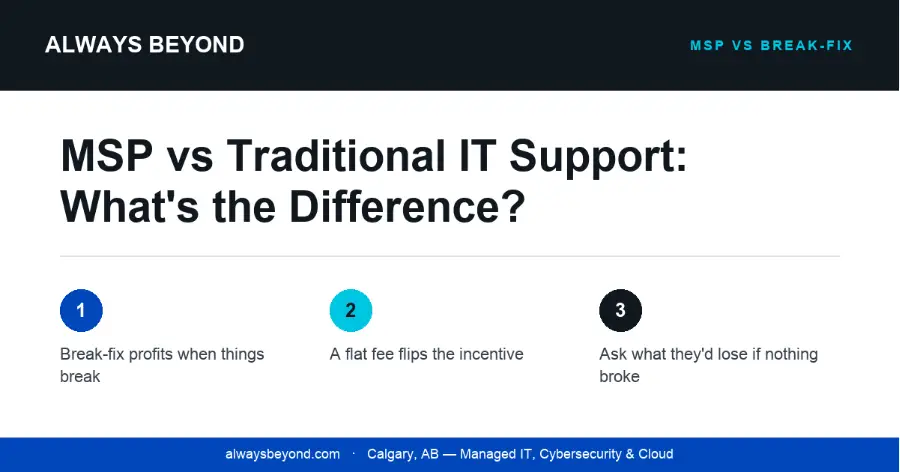
Here’s an uncomfortable question nobody asks their IT guy: what happens to his invoice if nothing ever breaks? If you’re on a break-fix contract, the honest answer is that his invoice shrinks. He gets paid when your server crashes, when your network goes down, when you call in a panic on a Tuesday afternoon. A slow, stable, boring network is bad for his business. That’s not a conspiracy theory, it’s just how the billing works, and once you see it you can’t unsee it.
This is the actual dividing line between old-school break-fix support and an IT support managed service provider, and it has nothing to do with buzzwords. It’s about who benefits when things go wrong. A flat-fee arrangement flips the incentive: the provider gets paid the same whether your systems hum along quietly or catch fire, so their entire financial interest is in making sure nothing catches fire in the first place.
I’ve talked to enough small business owners to know the break-fix model doesn’t feel broken until you actually sit down and map out the incentives. On paper, paying by the hour or by the ticket sounds fair. You only pay for what you use, right? Except what you’re buying isn’t uptime, it’s downtime, dressed up as a service call. The technician who fixes your problem fast and leaves has no reason to look upstream at why the problem keeps recurring. Diagnosing the root cause takes time, and time is the one thing that isn’t in his interest to save.
Managed services rearrange the whole relationship around prevention instead of repair. Monitoring runs quietly in the background instead of waiting for a phone call. Patches get applied on a schedule instead of after an exploit already worked. Backups get tested instead of assumed. None of this is glamorous, and that’s rather the point: the entire model is a bet that boring, well-maintained infrastructure beats dramatic heroics every time.
Here’s the comparison stripped down to what actually changes.
| Break-fix support | Managed service provider | |
| Gets paid when | Something breaks | Every month, regardless |
| Financial incentive | More incidents | Fewer incidents |
| Typical response | After the outage | Ongoing monitoring, before it escalates |
| Security posture | Reactive, patch after the fact | Proactive, aligned to a framework |
| Budget predictability | Spiky, unpredictable invoices | Flat, known monthly cost |
| Relationship | Vendor called in a crisis | Partner tracking systems continuously |
None of this means every break-fix technician is scheming against you. Most are decent, hardworking people doing exactly what their business model rewards. That’s the problem: you don’t need bad actors to get bad outcomes, you just need misaligned incentives left alone long enough. A doctor paid per surgery and a doctor paid a salary to keep patients healthy will practice medicine differently even with identical training and identical intentions.
Cost is where this usually gets litigated, and it’s worth being honest about it. A flat monthly fee can look more expensive than an occasional break-fix invoice, right up until the month your server dies on a Friday and drags a weekend of lost revenue behind it. Managed pricing isn’t cheaper because the labor costs less. It’s cheaper because you’re no longer gambling on when the bill arrives and how big it turns out to be. Predictability has real value, even when it doesn’t show up as a line item.
There’s also a quieter difference that rarely makes it into the pitch: what happens between incidents. A break-fix shop has no reason to think about your systems when the phone isn’t ringing. A managed provider is watching patch levels, checking backup logs, and asking whether your setup still matches how the business actually operates now, not how it operated when the contract was signed. That ongoing attention is worth more than any single repair, because it’s the difference between finding a problem before it costs you a day and finding out about it from an angry customer.
For a small or mid-sized business in Alberta, the practical test is simple: ask your current provider what they’d lose if your systems just stopped needing them. If the honest answer is revenue, you already know whose interests are actually being served. If it’s nothing, because the fee stays the same either way, you’ve found a provider whose incentives point the same direction as yours.
