
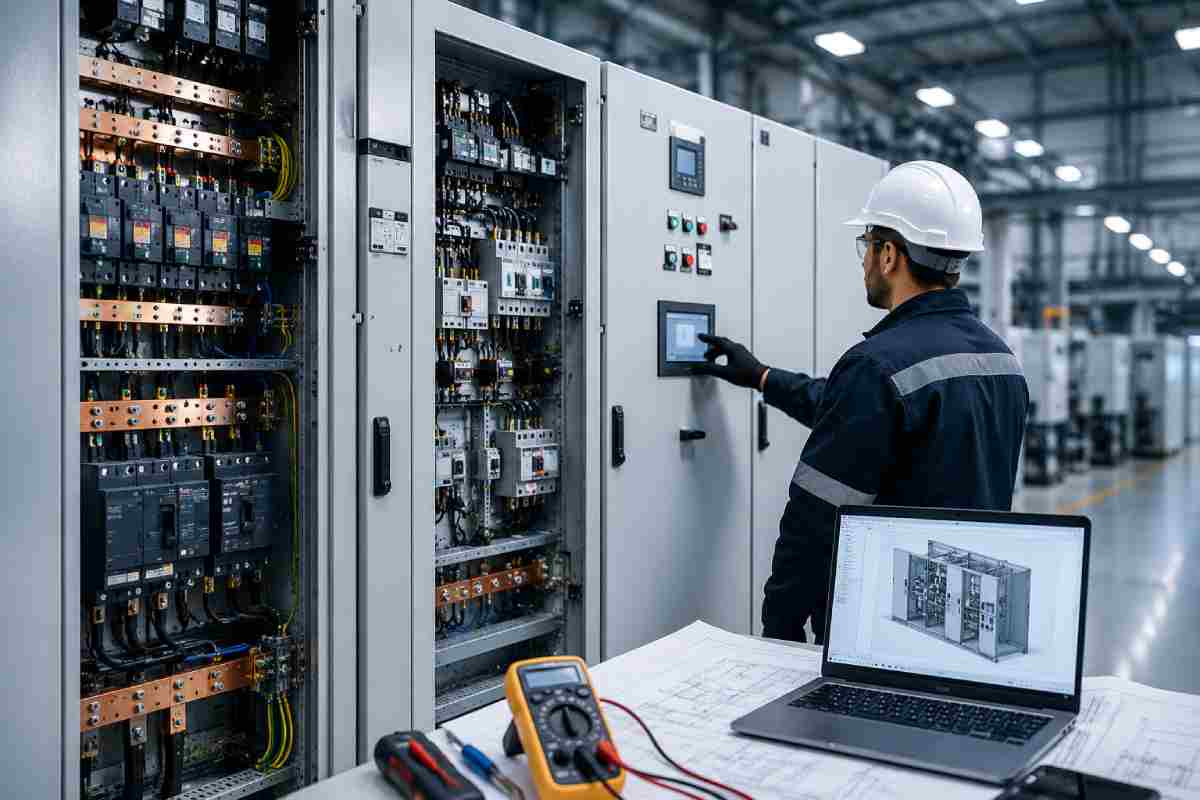
Custom switchgear plays a critical role in protecting power systems for data centers, utilities, and industrial facilities. Yet many engineers and executives face the same frustrations when sourcing equipment. Standard suppliers often deliver rigid off-the-shelf solutions with lead times that span months. Some manufacturers are tackling these challenges differently, delivering engineered solutions faster and with greater flexibility than traditional providers.
Table of Contents
Leading Custom Switchgear Solutions: A Look at Three Case Studies
The following examples illustrate how three manufacturers approached complex power infrastructure challenges with distinct strategies.
1. Lake Shore Electric: A Custom Switchboard for Greenlane’s EV Charging Network
Lake Shore Electric, a U.S.-based manufacturer that excels in bespoke switchgear solutions, worked with Greenlane Infrastructure to address a critical challenge in its national electric vehicle charging network buildout. The project required reliable power distribution equipment capable of fault current limitation while maintaining operational resilience.
Lake Shore Electric designed a customized R Series rear-connected UL 891 switchboard for the project. The solution incorporated fault-current-limitation technology and streamlined installation through factory pre-assembly and testing. This approach ensured that equipment met rigorous safety standards before arriving on-site, reducing installation complexity and supporting reliable operation.
This case study reveals key differentiators. Custom engineering allowed Lake Shore Electric to address specific electrical requirements rather than forcing a standard solution. Factory pre-assembly and testing reduced field installation time and potential errors while ensuring operational resilience, which is critical to charging network uptime.
2. ABB: Ensuring Industrial Power Reliability with Advanced Technology
ABB worked with Colorado Springs Utilities to address aging air-insulated switchgear that posed both safety and sustainability concerns. The existing equipment occupied significant space, and the organization wanted a solution that would align with its environmental commitments while maintaining a smaller physical footprint.
ABB engineered a customized medium-voltage switchgear package designed to meet both the sustainability goals and space constraints. The new equipment incorporated advanced technology that reduced the installation’s environmental impact. The solution continues to support the utility’s sustainability initiatives while prioritizing employee safety through modern safety features.
This project highlights the importance of manufacturers who can balance multiple requirements. Technical performance, environmental considerations, and physical constraints all influenced the final design.
3. Eaton: Upgrading Utility Infrastructure with Strategic Refurbishment
Eaton partnered with an investor-owned utility facing a common infrastructure challenge. The utility’s motor control center and low-voltage switchgear had aged beyond their expected service life, with some components showing visible damage. Complete replacement would have been costly and time-consuming.
Eaton provided a turnkey refurbishment solution that modernized the existing equipment rather than replacing it entirely. The approach involved upgrading key components to current UL-listed standards and installing AAA-tested devices throughout the system. The refurbished switchgear extended the equipment’s operational life while improving overall reliability.
This strategy demonstrates how experienced manufacturers can offer alternatives to full replacement. Refurbishment requires deep knowledge of both legacy systems and current standards, along with the engineering expertise to integrate new components with existing infrastructure.
What Sets Top-Tier Switchgear Manufacturers Apart
The case studies above reveal common characteristics among manufacturers who consistently deliver results. These qualities address the most pressing concerns facing power systems engineers and utility executives.
A Commitment to Domestic Manufacturing and Supply Chain Stability
Overseas manufacturing introduces significant risks for critical power infrastructure projects. Supply chain disruptions can extend already long lead times by months. Political instability, shipping delays, and customs issues add unpredictability to project schedules.
U.S.-based manufacturers offer greater supply chain stability and faster response times. Domestic production facilities can adapt more quickly to design changes and accelerate delivery when projects require expedited timelines. The broader power industry has experienced equipment shortages, including challenges addressing power transformer shortage that have affected utilities nationwide. Working with domestic manufacturers reduces exposure to these supply chain vulnerabilities.
Proximity also improves communication and collaboration. Engineers can visit manufacturing facilities to review prototypes, inspect quality control processes, and resolve technical questions in person rather than coordinating across time zones.
Deep Engineering Support and Customization Capabilities
Many projects require equipment that doesn’t match standard catalog specifications. Unusual voltage requirements, non-standard physical dimensions, or specialized environmental conditions demand custom engineering. Large original equipment manufacturers often lack the flexibility to accommodate these variations without prohibitive costs or extended timelines.
Leading manufacturers offer collaborative engineering support from the initial design phase through final installation. Their teams work directly with clients to understand specific project requirements and develop solutions that address unique challenges. This approach transforms equipment procurement from a transactional purchase to a partnership focused on problem-solving.
Customization capabilities extend beyond basic modifications. The best manufacturers can design entirely new configurations, integrate proprietary control systems, and engineer solutions for environments with extreme temperature, humidity, or space limitations.
Unwavering Adherence to UL Standards and Realistic Lead Times
UL Standards provide companies with clear safety guidelines. Reliable manufacturers maintain transparent certification processes and provide documentation verifying that their products meet UL safety standards without exception. This commitment to quality ensures that custom switchgear performs reliably under demanding conditions.
Equally important is the ability to provide realistic lead times. Some manufacturers promise aggressive delivery schedules that they cannot meet, creating cascading delays across entire projects. Top-tier partners assess their capacity honestly and communicate timelines based on actual production capabilities. When challenges arise, they maintain open communication rather than allowing issues to surface at the last minute.
This transparency allows project managers to plan accurately and coordinate related work. A manufacturer who delivers on schedule becomes a trusted partner for future projects.
Frequently Asked Questions About Custom Switchgear
Learn more about evaluating manufacturers and planning power infrastructure projects.
Are consultations on switchgear design specifications typically available?
Most reputable manufacturers provide engineering consultations during the design phase. These sessions help identify potential challenges early and ensure the final design meets technical requirements and budget constraints.
What are the benefits of custom switchgear for data centers?
Custom switchgear addresses data center requirements for reliable power distribution with minimal downtime. Engineered configurations fit tight space constraints while providing redundancy and monitoring capabilities. Solutions can be optimized for specific power densities and future expansion needs.
Securing the Right Partner for Power Projects
The best manufacturing partners combine customization capabilities, engineering expertise, domestic production, and a demonstrated track record of delivering on commitments. They approach each project as a problem to solve rather than a product to sell.
